Which or that: what is the rule in British English?
With commas, always which. Without commas, take your pick. Almost everything else is about the commas.
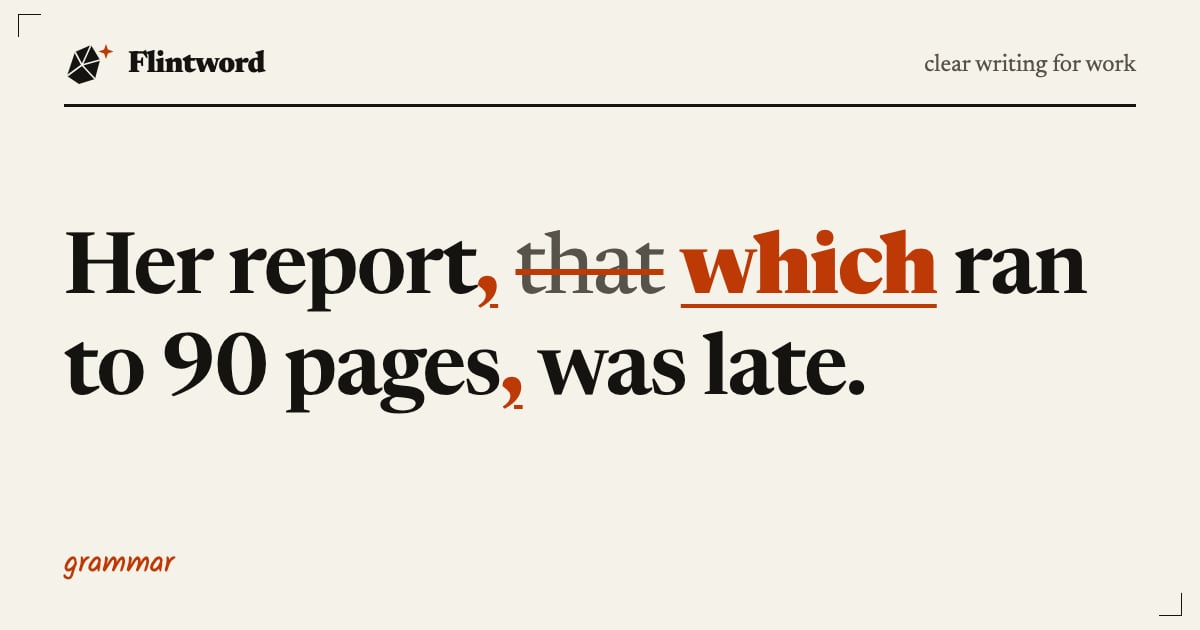
If the clause adds extra information and sits between commas, use ‘which’, never ‘that’. If the clause identifies the thing you mean, and has no commas, British English allows ‘that’ or ‘which’. So ‘that’ is the word you can get wrong. ‘Which’ is correct in both.
Cambridge Dictionary’s grammar reference gives this pair of examples, and says we can use ‘that’ in place of ‘who’, ‘whom’ or ‘which’ in defining clauses, but not in non-defining ones:
- Here are some cells which show abnormality. (Also correct with ‘that’.)
- Her car, which was very old, broke down after just five miles. (Not ‘Her car, that was very old’.)
Grammarians call these defining and non-defining relative clauses. You can forget the names, provided you can tell them apart.
A test that takes five seconds
Take the clause out and read what is left. If the reader can still tell exactly which thing you mean, the clause was extra. If they can no longer tell, it was essential.
Those two rota sentences are not interchangeable. ‘The rota that I sent on Monday is final’ suggests there were several rotas, and picks one out. ‘The rota, which I sent on Monday, is final’ suggests there is only the one, and adds in passing when you sent it.
The comma is doing the real work
Cambridge gives a neat example of how much hangs on this. In ‘His brother, who works at the supermarket, is a friend of mine’, the man has one brother. Without the commas, he has more than one, and you are saying which one you mean. The words are identical. Only the punctuation changes.
At work this can have consequences:
| As written | What it says |
|---|---|
| Staff who have completed the training can use the new system. | Only some staff. The clause tells you which ones. |
| Staff, who have completed the training, can use the new system. | All staff, who have all done the training. Probably not what HR meant. |
| We will refund orders which arrived damaged. | Only the damaged orders. |
| We will refund orders, which arrived damaged. | Every order, all of them damaged. An expensive comma. |
Cambridge is firm on this point: in writing, we do not use commas with defining clauses. If you put a pair of commas round a clause, you are telling the reader they can skip it.
Do not forget the second comma
A non-defining clause in the middle of a sentence needs one comma before it and one after, working like brackets. Losing the second is a very common slip:
| Corrected | Note |
|---|---|
| The Leeds office, which opened in May, is hiring. | Without the second comma, the sentence seems to say May is hiring. |
| The new policy, which takes effect in April, applies to all teams. | The closing comma was missing, so the clause seemed to run on. |
So which one should you write?
In a defining clause, both are correct, so this is a matter of feel. Cambridge notes that ‘that’ is very common in informal speech, and lists it as informal in its table of relative pronouns. We make three practical suggestions:
- Use ‘that’ if your text is everyday workplace writing and it sounds natural.
- Use ‘which’ if the sentence already has ‘that’ nearby, as in ‘the idea that the report which she wrote was late’. Better still, rephrase.
- Use whatever your organisation’s style guide prescribes. Some prefer one over the other, and a consistent document looks better cared for.
Do not lose sleep over a colleague’s choice. If you are editing someone else’s work, changing a correct ‘which’ to ‘that’ adds nothing the reader will notice.
Cases that look like exceptions
Often you need neither
Cambridge notes that we often leave out the relative pronoun when it is the object of the verb. ‘The report that she wrote’ can simply be ‘the report she wrote’. This is shorter, and it fits the plain English approach. You cannot do this when the pronoun is the subject of the clause: ‘the report that arrived late’ needs its ‘that’.
People
Use ‘who’ for people in non-defining clauses. In defining clauses, Cambridge shows ‘the people who bought our house’ and ‘the people that bought our house’ as both acceptable, the second being common in informal speech. In formal writing, ‘who’ is the more comfortable choice.
Which about a whole idea
‘Which’ can refer to a whole clause and not only to one noun: ‘The meeting overran, which meant we missed the train.’ ‘That’ cannot do this. Check that the reader can see what ‘which’ refers to. In ‘We moved the deadline for the report, which annoyed the client’, it is not clear if the client minded the deadline or the report.
After a preposition
Only ‘which’ can follow a preposition directly: ‘the budget on which we agreed’ is correct, while ‘the budget on that we agreed’ is not. Cambridge notes that some formal styles prefer this position, but ‘the budget we agreed on’ is fine in most workplace writing, and easier to say.
Five to mark up
Try these before reading the answers.
- Our Bristol office, that opened in 2019, is moving.
- Please use the template that I attached.
- The figures which are in the appendix are provisional.
- The chair, who was unwell, left early.
- The invoice, which we paid on Friday has been queried.
Answers. In the first, change ‘that’ to ‘which’, since there is only one Bristol office. The second is correct. The third is correct if only the appendix figures are provisional, and if every figure is in the appendix, it needs commas. The fourth is correct. The fifth needs a comma after ‘Friday’.
These are the kinds of slip worth a dedicated search when you proofread your own writing, since a spellchecker will rarely help. If you enjoy this sort of question, try our piece on the passive voice, another piece of grammar that gets more blame than it deserves.