What is plain English, and how do you write it at work?
Writing your reader understands the first time. It is a skill for grown-up documents, and it loses no precision if you do it properly.
Plain English is writing that the intended reader can understand the first time they read it. At work, that mostly comes down to saying who does what and by when, in familiar words and short sentences, with the most important point first.
It does not mean childish writing or informal writing. A contract, a safety notice or a board paper can all be plain and still exact. What goes is the padding around the meaning.
Who it helps
Everyone, and that is the surprise. GOV.UK makes plain English mandatory for its content and gives two reasons. First, many people struggle with difficult text: its guidance reports that 1 in 6 adults in England have very poor literacy skills, with comparable figures for Scotland, Wales and Northern Ireland, though the definitions vary by nation. Second, it reports research into legal documents in which 80% of people preferred sentences in clear English, and the more educated and specialist the reader, the stronger that preference.
So you do not need to dumb anything down for your clever colleagues. They would rather have the short version too, because it lets them get on with their day.
A memo, marked up
Here is an invented but familiar sentence from an office memo, along with one way to edit it.
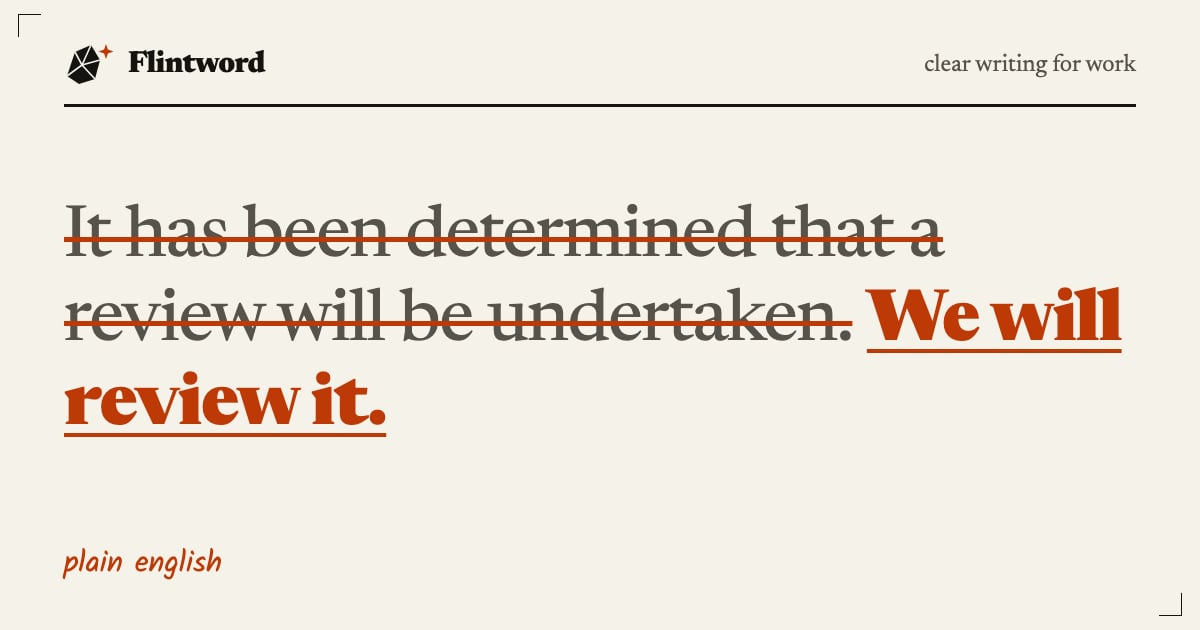
Further to recent discussions regarding the utilisation of meeting rooms, it has been determined that a review of the current booking arrangements will be undertaken by the facilities team, and staff are requested to ensure that any requirements are communicated prior to the end of the month.The facilities team is reviewing how we book meeting rooms. If you need anything changed, tell them by the end of the month.
Nothing has been lost. The reader now knows who is doing what and what they need to do, and they can see both at a glance. The edits below produced that change, and the last two add a little more.
Six edits that do most of the work
1. Put the doer in front of the verb
‘A review will be undertaken by the facilities team’ becomes ‘The facilities team is reviewing’. GOV.UK asks its writers to use the active voice because it is direct and keeps sentences short. There are exceptions, which we cover in a separate piece on the passive.
2. Turn hidden verbs back into verbs
Writers often bury the action in a noun, then need a weak verb to prop it up. ‘Carry out a review of’ is really ‘review’, and ‘make a decision’ is ‘decide’. GOV.UK warns that words ending in ‘-ion’ and ‘-ment’ tend to make sentences longer and more complicated. Search your draft for those endings and see what you can release.
3. Choose the shorter familiar word
GOV.UK’s own examples are ‘buy’ for ‘purchase’, ‘help’ for ‘assist’ and ‘about’ for ‘approximately’. Others you could try:
| Instead of | Try |
|---|---|
| use | |
| before | |
| if | |
| about | |
| to | |
| now |
The Plain English Campaign publishes a longer list in its A to Z of alternative words, one of several free guides.
4. Watch your sentence length
GOV.UK advises splitting sentences of more than 25 words and keeping paragraphs to no more than five sentences. The help page for the Plain English Campaign’s Drivel Defence checker expects an average of 15 to 20 words a sentence. Treat these as prompts, and vary your rhythm. A page of identical 15-word sentences is its own kind of unreadable.
The simplest test is to read a sentence aloud. If you run out of breath, your reader will too. Our proofreading guide has more on this.
5. Put the point first
Many work documents narrate the writer’s process: we met, we discussed, we looked at the options, and here at last is the answer. Reverse it. Give the answer and then the reasoning for anyone who wants it. This matters most in an email subject line and in the opening of a report.
6. Say what you mean by ‘should’
‘Should’ and ‘may’ leave people guessing. GOV.UK separates three strengths: ‘must’ for a legal requirement, ‘need’ for something a process requires, and ‘can’ for something optional. You may not be writing about legal duties, but the same habit helps a team. ‘You must log your hours by Friday’ and ‘You can log your hours daily if you prefer’ mean clearly different things.
Where plain English has limits
Some terms have to stay. GOV.UK says specialist terms are not always jargon, and advises explaining them the first time you use them. If a precise phrase in a contract or policy has a settled legal meaning, do not swap it for a friendlier one without asking whoever is responsible for the document. Changing a word can change an obligation. If there is real legal risk, ask a solicitor.
Buzzwords are a different matter. GOV.UK suggests that you can generally get rid of them by breaking a term into what you are actually doing. ‘Leverage our synergies’ tells nobody anything. ‘Share one payroll team across both offices’ can be argued with, which is a sign that it says something.
A note on contractions
GOV.UK uses positive contractions such as ‘you’ll’, but avoids negative ones such as ‘can’t’ and ‘don’t’, because many readers find them hard to read or misread them as the opposite. That is a good policy for instructions and public information. A friendly email between colleagues can reasonably use whichever comes naturally. The tone you set at the top of the message matters too, and we look at that in our piece on opening and closing work emails.
Start with one paragraph
You will not fix a whole department’s writing in a week, and you do not need to. Choose the next email you would have sent as it stood, and apply edits 1 and 3 to its first paragraph. Then check whether the reader can tell, from those few lines alone, what you need them to do. If they can, carry on doing the same thing.