Is the passive voice wrong?
It is correct English, and sometimes the better choice. The trouble starts when it hides who is going to do the work.
No. The passive voice is standard English grammar, and there are good reasons to use it. Grammar checkers flag it and writing guides warn against it because it can make sentences longer and vaguer, particularly when it leaves out who did something. That is a matter of style, and the answer depends on the sentence.
Even GOV.UK, which tells its writers to prefer the active voice, says that there are circumstances when the passive can work. So the useful question is smaller than ‘is it wrong?’ It is ‘does this particular passive help the reader?’
How to spot one
In an active sentence, the subject does the action. In a passive sentence, the subject receives it. The thing that was acted on moves to the front, the verb takes a form of ‘be’ plus a past participle, and the doer moves to the end or disappears.
A long-standing classroom trick helps: if you can add ‘by zombies’ after the verb and the sentence still makes sense, it is passive. ‘The budget was approved by zombies’ works. ‘The budget was late by zombies’ does not, because ‘was late’ is just a description.
That example matters because people often confuse the passive with anything containing ‘was’ or ‘were’. ‘She was writing the report’ is active, since she is doing the writing. ‘The report was written’ is passive.
When the passive earns its place
Cambridge Dictionary gives several reasons to use it: to focus on something, because the doer is unknown or unimportant, and to sound impersonal and create distance. These all come up at work.
The doer is unknown or obvious
‘The office was broken into overnight.’ Nobody knows who did it. ‘He was promoted in June.’ The reader does not need the name of the committee.
The outcome matters more than the agent
GOV.UK’s own example is ‘Biometric residence permits have been replaced by eVisas’. The news is what happened to the permits, so they belong at the front.
Reports of methods and processes
Cambridge notes that passives without agents are common in academic and technical writing, where the process matters more than the person. ‘Samples were taken at each site’ is more natural in a method section than naming the junior who held the bottle. If your discipline or client expects this style, follow it.
It is kinder to the reader
GOV.UK also allows passives when the writing is more centred on the user: ‘You’ll be told what you need to do when you apply’ keeps the reader in view, where naming the Home Office first would not.
Keeping the thread going
Sentences read best when they start with what the reader already knows. ‘We reviewed the contract last week. It was drafted by the legal team in May.’ The passive keeps ‘it’ at the front, connected to the sentence before.
When it causes trouble at work
GOV.UK’s objection is practical: the active voice is more direct and keeps sentences short, whereas the passive leads to longer sentences that are harder to read. In workplace writing we would add a second problem, which is that a missing doer often means a missing owner.
Minutes are the classic case. Read these lines and ask who has to do something.
| Passive, doer missing | Active, doer named |
|---|---|
| It was agreed that the figures would be circulated. | Priya will send the figures to the group by Friday. |
| Your application has not been progressed at this time. | We have not yet reviewed your application. |
| A decision will be communicated in due course. | We will write to you with our decision by 12 December. |
| Concerns have been raised about the rota. | Two team leaders told me the rota leaves Fridays short. |
In the first row, everyone leaves the meeting believing somebody else has the job. In the fourth, the passive makes a small worry sound like a formal complaint. (The names and dates in these rewrites are invented, and of course you need to know the real ones before you can write them down. Often the rewrite shows you that you do not.)
The apology problem
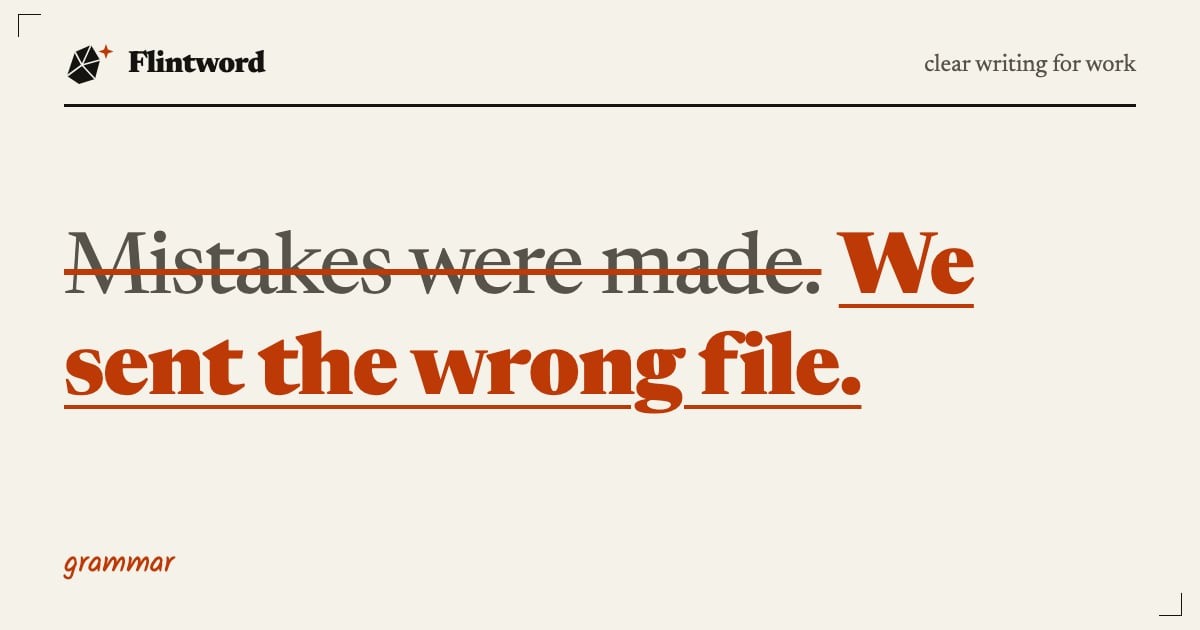
‘Mistakes were made’ is a notorious passive, and customers can hear what it is doing. Cambridge says the passive creates distance. In an apology, distance works against you.
| Keeps its distance | Takes responsibility |
|---|---|
| An incorrect invoice was issued to you. | We sent you the wrong invoice. I am sorry. |
| Your complaint was not dealt with in the expected timeframe. | We took too long to answer your complaint. |
There are times to stay cautious. If a complaint could become a legal dispute, get advice before admitting fault in writing. Otherwise, a plain sentence with ‘we’ in it usually lands better. For more on tone in messages like these, see our note on how to open and close work emails.
Sometimes the distance is right
Impersonal does not always mean evasive. ‘Your payment was declined’ avoids sounding as though a named person chose to embarrass the customer. ‘Three errors were found in the draft’ can be more tactful than ‘You made three errors’, especially when you are commenting on a colleague’s work in a group email. Use the passive deliberately for those moments, and take care that it is tact you are after, rather than cover.
Try this on your next draft
Search for ‘was’, ‘were’, ‘been’ and ‘be’, and look at each passive that turns up. For each one, ask three questions in your head: do I know who did it, does the reader need to know, and would the sentence be shorter with the doer in front? Change the ones where the answers are yes. Leave the others alone, without guilt.
You will not end up with a passive-free document, and you should not want one. A checker may flag what remains, as we say in our proofreading guide, but it cannot know why you chose it. This is one of the edits in our guide to plain English at work, and it pays off most in the opening of a report summary.