How do you write an executive summary for a report?
Write it last, keep it to about a page, and assume it is the only part of the report anyone will read.
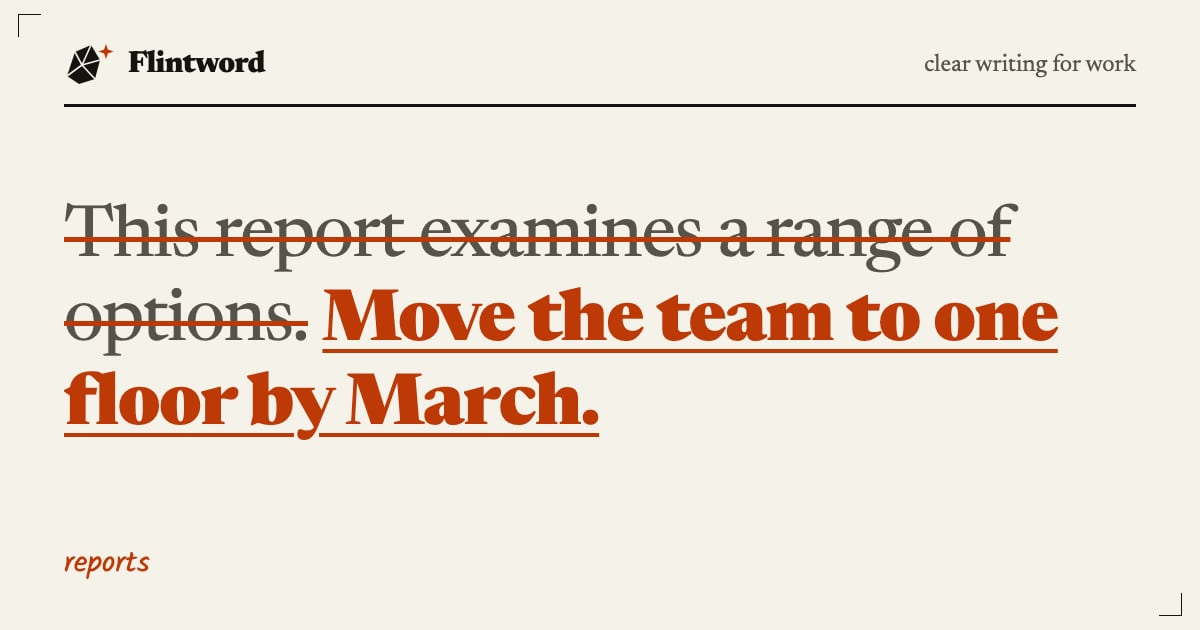
Finish the report first. Then write about one page that tells the reader what you recommend or found, why, how sure you are, and what has to happen next, so that someone who reads nothing else can still make the decision.
York St John University describes the purpose as giving a concise overview of the entire report, so readers can judge whether going further is worthwhile. Its guide recommends keeping the summary within a single page and writing it after the main report. Both points hold up well outside a university.
How a summary differs from an introduction
An introduction prepares the reader for the report. A summary can stand in for it. That one difference explains most weak summaries, which promise information when they should give it.
| Introduces | Summarises |
|---|---|
| This report examines the options for the office lease and sets out our recommendations. | We recommend renewing the lease for three years, because moving would cost more than it saves in that period. |
| Section 4 discusses the risks. | The main risk is a rent review in year two, which we would need to budget for. |
What goes in, and in what order
York St John lists what a summary may cover: aims, literature review, methodology, results, discussion, recommendations and conclusions, each in brief. That is a good list of ingredients. For a university assignment, following the order of the report is often what the marker expects, so check the brief.
For a report written to support a decision at work, we would rearrange them and bring the conclusion to the top. GOV.UK’s writing guidance calls this frontloading: put the most important information first, then taper down to smaller details. It describes this as an ‘inverted pyramid’.
Taking those five positions in turn:
- What we recommend. One or two sentences, stating the decision needed and who needs to make it. If the report recommends nothing, give the main finding here.
- Why. The two or three findings that lead to it. Include the figures that drive the decision.
- How we know. A line on the evidence: what you looked at, over what period, and any serious gap in it.
- What could go wrong. The real risks and the alternative you rejected. A reader who sees these trusts the rest more.
- What happens next. Who does what, and by when.
A worked example
Here is a short summary built to that pattern. The organisation and its numbers are invented for this page.
Recommendation. The board should approve moving the support team from two floors to one by the end of March.
Why. The team uses about half of the desks on the two floors on a typical day. Giving up the upper floor would reduce annual rent by £48,000, against a one-off move cost of £15,000.
Evidence. We counted desk use for eight weeks and interviewed all four team leaders. We did not measure use during the January peak.
Risks. Peak weeks could be tight. We considered a shared desk rota as a fallback and costed it in section 5.
Next step. If approved at the December meeting, the facilities manager will give notice on the upper floor by 15 January.
That is about 120 words, and it holds everything a board member needs in order to say yes, say no, or ask a good question. Notice how each sentence says who does what. Writing that names the doer, in the active voice where it helps, makes accountability hard to miss.
How long it should be
There is no single rule, so use the limit you have been set, if any. York St John says the length varies with the report and the assessment guidelines, and recommends a single page. We would treat a page as the ceiling for most work reports, and half of one for short reports. If yours has spilled onto a second page, the likely cause is method and background. Cut those first.
Mistakes that are easy to fix
- Something new appears
- Every fact in the summary must also be in the report. If you discover a good point while summarising, add it to the body as well.
- Figures do not match
- You rewrote section 3 on Thursday and the summary still has last week’s total. Compare each number against its source.
- Sentences pasted from the body
- Those were written to follow the sentences around them. Lifted out, they lean on context the reader does not have. Rewrite them.
- Abbreviations nobody has met yet
- A reader may start here and stop here. Spell out terms in full, or explain them, as if the report did not exist.
- Throat-clearing
- ‘This summary provides an overview of’ uses up the opening, which is the part most likely to be read. GOV.UK notes that people often skim web pages, and it cites a figure of only 20 to 28% of the text being read. A report is not a web page, but a tired director behaves in much the same way.
Check it on someone who has not read the report
Hand the page to a colleague who knows nothing about the project. Ask them what you want, why, and what would happen next. If they cannot answer, the fault is on the page. This takes five minutes and finds more than rereading does.
Then give the summary its own close read, using the passes in our proofreading guide, because it is often written last and in a hurry. The same habits apply to the rest of the report, and the plain English edits carry over directly. The Plain English Campaign also lists a free guide to writing reports among its free guides, if you would like a longer treatment.